The link fails first.
Most C2 software assumes reachback. In contested spectrum the satellite link, the cloud tenant, and GPS are the first things to go, and the software goes with them.
Mission software for the tactical edge
EdgeLance puts every device, drone, vehicle, and aircraft in the fight under one plan, one picture, and one task list. It runs on the hardware the unit already carries and syncs across whatever link is left.
The problem
Defense software has been built from the headquarters down. The team at the edge gets whatever still works after the network degrades, and usually that is a radio and a notebook.
Most C2 software assumes reachback. In contested spectrum the satellite link, the cloud tenant, and GPS are the first things to go, and the software goes with them.
An approved order becomes a PDF, a slide, and a string of radio calls. Turning a plan task into an asset that is moving is still done by hand.
Cameras, drones, RF, and ADS-B now produce more cues than a team can work. Nobody fuses them at the level where the team has to act.
Map in one tool, chat in another, files on a share drive, AI in a browser tab that needs the internet. Each handoff is a seam where information gets lost.
What EdgeLance does
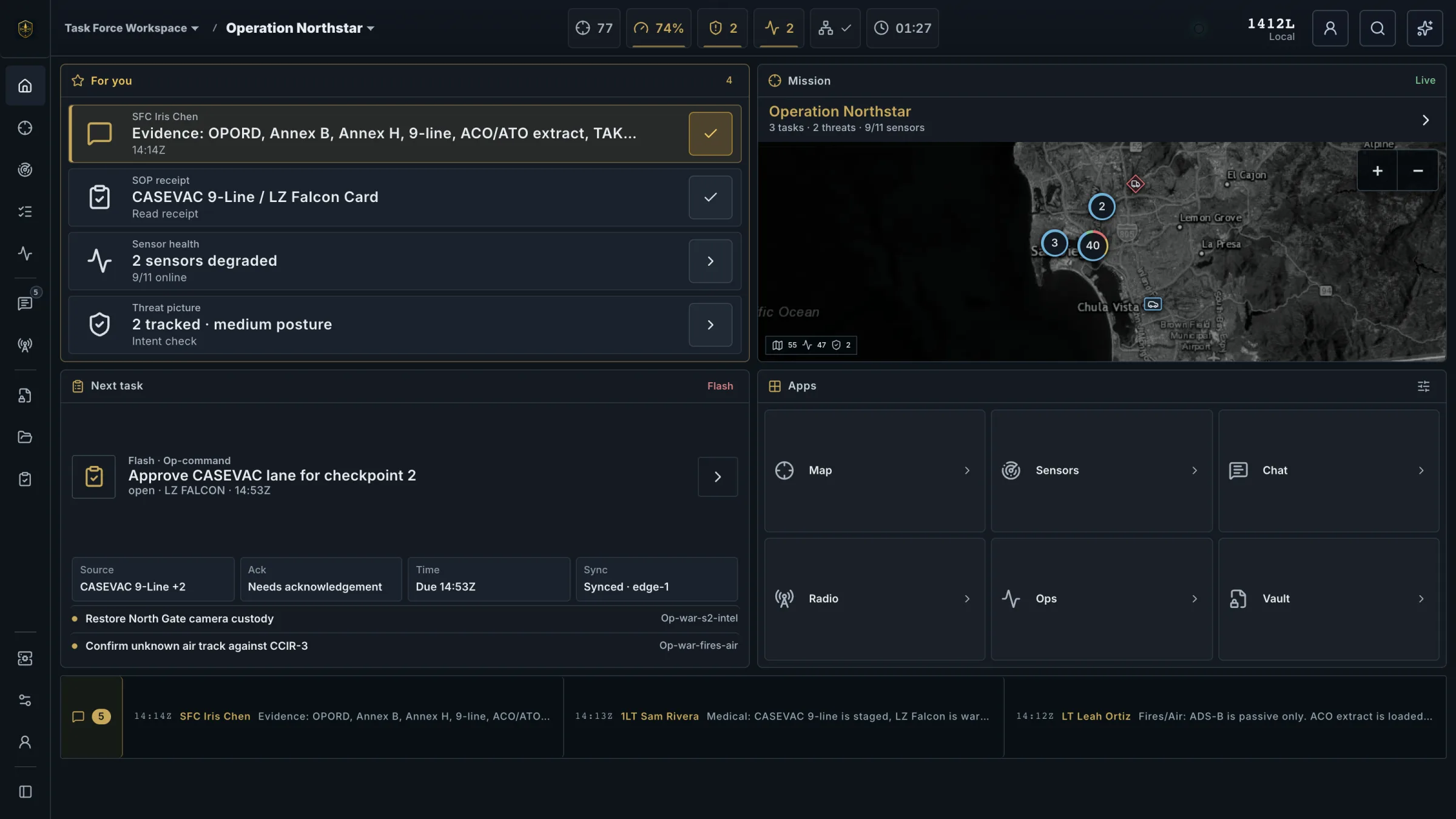
Planning, the operating picture, tasking, team traffic, and review share one mission record that lives on the team's own devices.
Each operator opens to what needs their attention: decisions, tasks, sensor health, and team traffic for the operation they are on.
Hardware agnostic
Units fight with programs of record, commercial devices, drones from a dozen makers, and aircraft they do not control. Each arrives with its own app and its own picture. EdgeLance puts them under one plan, one picture, and one task list, and keeps the operator in command of all of it.
Read the interoperability paper →Issued and commercial phones, tablets, laptops, servers
One application on whatever the unit carries. Windows, Android, macOS, iOS, or Linux.
Air, ground, and sea, from any vendor
Every asset on one roster. Tasks go to the asset that can execute them, regardless of maker.
Crewed aircraft, ADS-B, airspace control measures
Crewed and uncrewed traffic on one picture. The drone crew sees the helicopter before the helicopter finds the drone.
Cameras, radar, RF, acoustic, radios
Each sensor reports in a common form. Adding one adds detections, not another screen.
Enterprise C2, staff planning tools, TAK
Approved tasks come down from the plan. Approved data goes back up. EdgeLance connects, not replaces.
Where it fits
EdgeLance does not replace enterprise C2, staff planning tools, or TAK. It connects to them and covers the part of the mission they were never built to reach.
Enterprise and staff
Enterprise C2 platforms, staff planning tools, intelligence systems
Builds the plan and the strategic picture. Assumes a connection.
EdgeLance
Mission workspace, local AI, sensor fusion, tasking, mesh sync, mission record
Runs the mission where it happens. Takes approved tasks down, sends approved data up, and keeps working alone in between.
Transport and devices
Radios, TAK, satellite, mesh, phones, laptops, drones, sensors
Moves the bits and carries the compute. Has no mission logic of its own.
Evidence
EdgeLance is early: demonstrated, not yet fielded. Each claim below links to the write-up.
Jun 2026
Run live on a laptop command node, phones, a smartwatch, and cameras for platform engineers and senior military leaders. The feedback shipped as product capability.
Read the write-up →
Jul 2026
A simulator ran distributed assignment of twenty interceptors against forty inbound tracks under four communications conditions. It models the logic. It is not fire control.
Read the write-up →
Oct 2026
Three nodes in a line. With a link cut, both sides kept working. When it healed, they converged in under a second. A node with no peers kept running.
Read the write-up →
Two ways to buy
Deploy the mission system as it ships, or bring a workflow and our forward-deployed engineers will build the app around it.
Run EdgeLance
License EdgeLance and run it on the unit's own hardware. Mission templates set models, sync, and approval policy for the mission, and the team is planning, sensing, and tasking from the first day.
Build on EdgeLance
Our forward-deployed engineers sit with your operators and build the app your workflow needs on EdgeLance's working blocks. The engineering goes to your rules, your data, and your screens, not to rebuilding what already works.
Why now
$93.6M
Army NGC2 application awards, Oct 2026
The Army is fielding the NGC2 network and has started buying the applications that run on it. Corps headquarters got the transport first. The layer below the command post is next.
Source ↗$54.6B
FY27 autonomous warfare request
Small drones are now bought by the hundred thousand and treated as consumables. Every one of them is a sensor and an asset that some team has to task, track, and deconflict.
Source ↗4-star
Autonomous Warfare Command, announced Sep 30
The Department plans a combatant command for drones, AI, and the C2 systems that direct them. Autonomy at that scale needs software that works where the autonomy operates.
Source ↗What it is worth
Any model. Any hardware. Any mission.
Mission data, models, prompts, outputs, and the record belong to the customer. When a mission ends, the burn destroys the keys and the signed record proves it, so command knows when intelligence was created, who saw it, and when it was destroyed.
The operator on the ground generates most of what the enterprise eventually fuses. EdgeLance makes that data useful to the team first, then sends it up in a form the enterprise can trust.
AI answers carry their sources. Recommendations carry their reasoning. Every approval, override, and dispatch is attributed to a person and kept in the record.
Research
Whitepaper
In Grenada in 1983, American forces could not talk to each other. Goldwater-Nichols unified command but not equipment. New hardware, military and commercial, now arrives by the hundred thousand, each piece with its own app and picture. This paper sets five tests for hardware-agnostic mission software across operators, vehicles, aviation, sensors, and C2.
Read the paper →
Analysis · Nov 10, 2026
On November 9 five federal departments signed a memorandum on testing and deploying counter-drone technology at home, with the FAA reviewing safety. Approvals are getting faster and more than 24,000 counter-drone systems reached CENTCOM this year. Every engagement near civil airspace will be reviewed, and the review starts with the site's own record.
Analysis · Nov 6, 2026
Since October 1 every Marine Corps command, reserves included, can use Maven Smart System on any network it is cleared for. More than 100,000 people across the department now use it. Enterprise platforms are winning at echelon. A disconnected team layer adds data captured at the source, sync on reconnect through open standards, and continuity when reachback is gone.
Analysis · Nov 2, 2026
The Army's Accelerated Capability Events take 150 to 250 industry responses down to 15 vendors and five contracts, with soldiers running the demonstration and the commander making the call. Two more events run this month. A soldier-led demo and a leave-behind period expose software that needs a link or a vendor engineer to work.
Briefings
A working session on your mission thread: planning through disconnected execution and review, on hardware your team already has.