Platform
One mission, from first plan to final review.
EdgeLance is a mission operating system. It holds the plan, the picture, the tasks, the team's traffic, and the record in one place, on the team's own devices, so the mission does not depend on a connection to anywhere else.
How it works
Six things a team has to do. One system that does them.
Prepare
01Stage the mission before step-off.
Build the mission pack: roles, overlays, documents, approved models, sensor plan, and access policy. Each device gets the loadout its role and hardware can carry, so the team leaves ready instead of improvising.
See
02Fuse what every sensor reports.
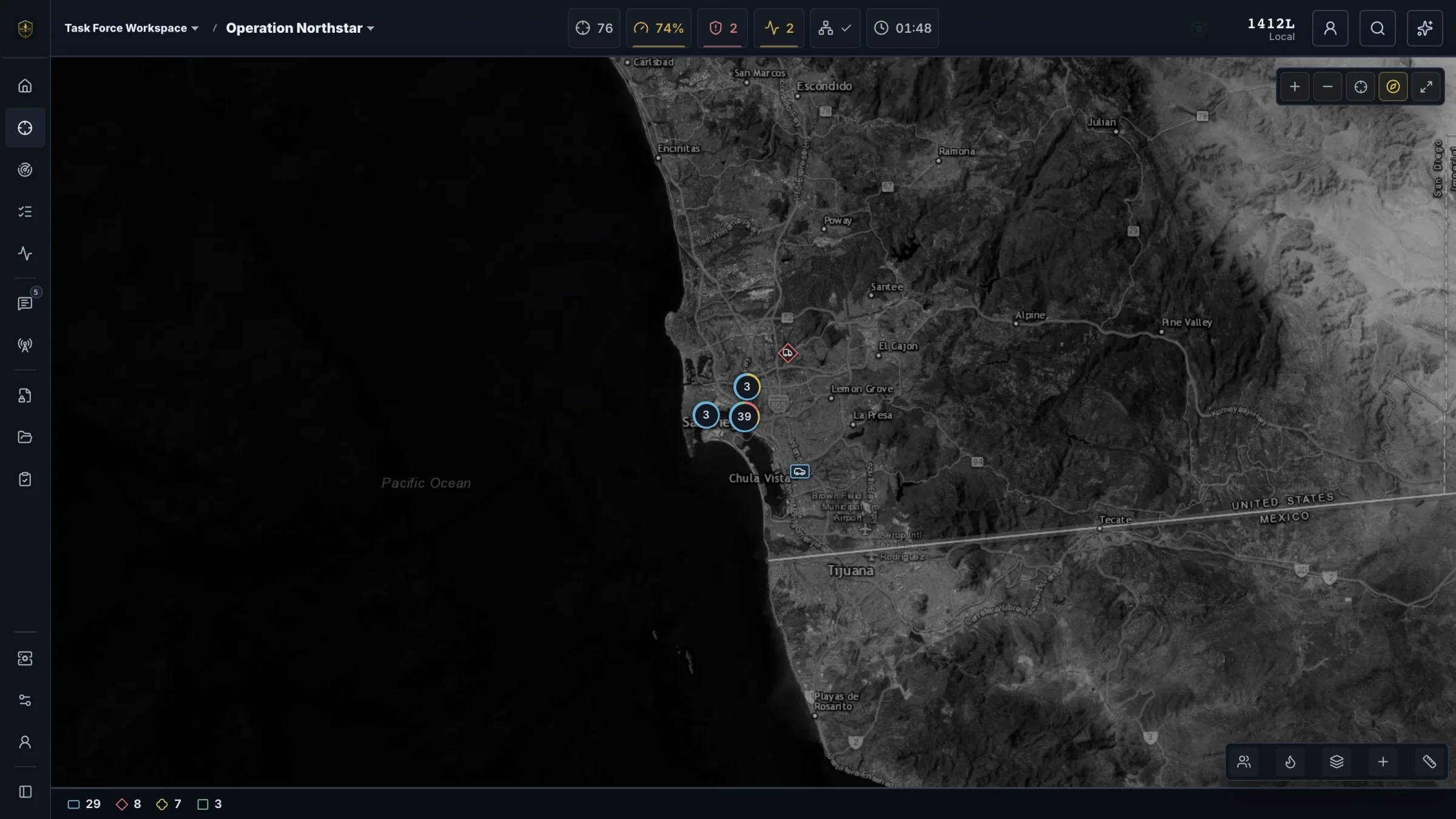
Cameras, drones, RF, ADS-B, vehicle telemetry, radio traffic, and operator reports become tracks on one local picture. Each observation keeps its source, its time, and how much it should be trusted.
Decide
03Get answers with the source attached.
Ask the mission AI a question and the answer cites the order, the annex, or the sensor event it came from. It runs on the device or on a local server, using whichever approved model the unit chooses.
Act
04Move approved tasks to the assets that execute them.
An approved plan task becomes a signed directive. EdgeLance offers it to the assets that can take it, tracks who accepted, and returns field receipts and the live target track to the task.
Sync
05Stay coordinated on whatever link is left.
Mission state replicates device to device over the EdgeLance mesh, relaying across multiple hops. A node that loses every peer keeps working and catches up when a path returns.
Learn
06Review what actually happened.
Replay the operation by decision point. See what each person knew and when. Build the after-action review from the record, then burn the mission data with proof that it is gone.
The product
What the team sees.
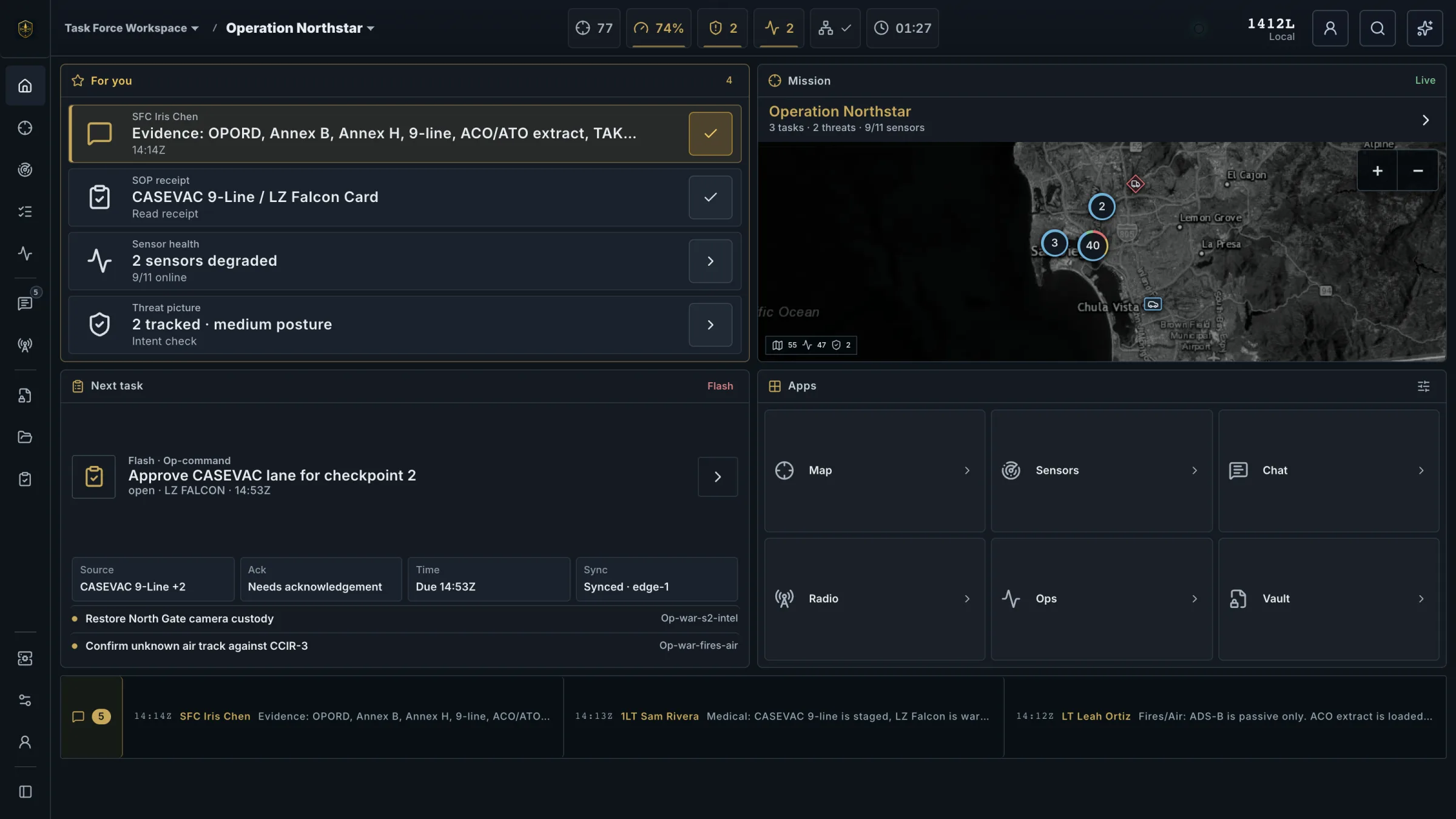
Workspace
Decisions, tasks, sensor health, and team traffic for the active operation.
Mission blocks
Build the mission from parts that already fit.
Every EdgeLance capability ships as a block: a packaged component that declares what it consumes, what it produces, and what it is allowed to do. Blocks share one mission vocabulary, so a detection from one vendor's camera means the same thing to the tracker as a report from another vendor's drone.
A program composes the blocks its mission needs, and EdgeLance validates the composition before anything deploys. AI agents can use the same catalog to assemble deployments that are valid by construction.
Blocks are also how our forward-deployed engineers build custom mission apps. See how custom apps work →
Object detection
Camera feeds become typed observations with location, class, and confidence.
ADS-B surveillance
Aircraft reports become positioned observations on the air picture.
Vehicle telemetry
Friendly vehicles and drones report position and health into the asset roster.
Track custody
A multi-domain tracker holds identity across sensors and refuses spoofed or backdated inputs.
Asset tasking
Tracked targets are offered to available assets, with leases that lapse if nobody executes.
Plan dispatch
Approved plan tasks are signed, bound to their mission, and dispatched for execution.
Maritime fusion
AIS and surface contacts fused into maritime tracks.
Interoperability
Bring the hardware you have.
No unit fights with one vendor's equipment. EdgeLance connects through open military and commercial standards, translates each source into the mission vocabulary once, and runs every asset from one task list. A new drone or sensor joins the mission without a new screen.
One Mission, Any Hardware →Vehicles
MAVLink autopilots and ROS 2 robots report position and health into one roster. Air, ground, and sea, any maker.
Aviation
ADS-B traffic and crewed aircraft on the same air picture as the unit's drones.
Imagery and video
MISB KLV full-motion video metadata and NITF imagery, geolocated on arrival.
Sensors and RF
Cameras, radar, acoustic, software-defined radio, and AIS, each reporting in one form.
Radios and links
MANET radios, satellite terminals, cellular, Wi-Fi, and low-power mesh, used as available.
C2 and maps
TAK, enterprise C2, and GeoPackage map data, in and out, at the release level the unit sets.
Deployment
From the operator's phone to the air-gapped cluster.
Field devices
Phones, tablets, and laptops run the workspace and local AI on their own, across Windows, Android, macOS, iOS, and Linux.
Forward server
A local server or Kubernetes cluster at the command post adds compute and becomes the preferred node without becoming a dependency.
Air-gapped networks
EdgeLance installs from one signed package into disconnected Kubernetes environments, with each mission block as an optional component.
Enterprise connection
When the team decides, approved tracks, tasks, and records flow up to enterprise C2, TAK, and partner systems.
Briefings
See it run on your mission.
We walk your mission thread from staging through disconnected execution and review.