The terminal did not keep the value
In 1981 IBM was computing. The company held the mainframe market the way a landlord holds a deed, and when it introduced the Personal Computer that August with a folksy advertising campaign, corporate America bought the machines in bulk. More than a million units sold within three years. The IBM name on the beige case told purchasing departments the machine was safe to buy.
But the PC broke IBM's own rules. To ship fast, the team used hardware and software from outside firms and published the design details. Clone makers copied the machine and often built it cheaper. And every clone ran the same operating system, MS-DOS, licensed from a small software company that IBM never thought to own outright. IBM had built a standard it did not control.
Nobody at IBM thought they were giving anything away. The operating system looked like plumbing. The applications looked like accessories. The money was in the iron and the service contracts, which IBM owned outright. Every one of those assumptions was reasonable, and every one concerned a layer that was about to stop mattering.
The bill arrived twelve years later. In July 1993 IBM reported an 8 billion dollar quarterly loss, then a record for American business. Fifty thousand employees took immediate early retirement. The workforce was falling from a 1985 peak of 406,000 toward a planned 225,000. The quarterly dividend was cut from 54 cents to 25. Revenue dropped 15 percent in a single year as mainframe demand collapsed underneath the company.
The value migrated. It left the hardware and settled in the layer where the actual work happened, the operating system and the applications that ran on it. The company that made the machine kept the least defensible part of its own creation. The terminal never keeps the value.
Where data is born
There is a name for what happened to IBM. Clayton Christensen wrote the canonical account in The Innovator's Dilemma, and he restated the theory with his coauthors in Harvard Business Review in 2015. Entrants win by starting where incumbents see no margin, then riding improvement curves up into the incumbent's core business. The PC looked like a toy to the mainframe division right up until it was the industry.
A second body of work explains where value settles once it moves. Marshall Van Alstyne and his coauthors showed in Pipelines, Platforms, and the New Rules of Strategy that platform businesses beat product businesses because network effects compound while product advantages erode. Ben Thompson's Aggregation Theory pushed the logic to its endpoint. When distribution costs nothing, whoever owns the user relationship at scale commoditizes everyone upstream. That framework called a decade of consumer internet winners in advance.
But aggregation carries a dependency that gets less attention than the theory itself. An aggregator is only as valuable as the supply it aggregates. Search needed the open web. The social feed needed the photographs. Aggregators won in consumer markets because production there was fragmented across millions of interchangeable suppliers, and no single producer had power. Concentrate the production and the power reverses. The owner of a scarce input negotiates with the platform rather than the other way around.
So the durable question in any technology stack is where the data is born and who owns that ground. Everything downstream of that point is a consumer and can be substituted. The point of production is welded to the event itself. In defense the event is a mission.
Defense runs the same stack with the labels changed. The consuming layer fuses and displays. The transport layer moves data between nodes. And the producing layer creates the entities everything else depends on, during missions, on whatever hardware made it outside the wire. Commercial history says the durable position forms at the producing layer, because it is the one layer that cannot be commoditized from above.
The defense map in 2026
The consuming layer of defense AI consolidated in plain view. In 2026 the U.S. Army awarded Anduril a contract with a 20 billion dollar ceiling to deploy Lattice, an open architecture command and control platform for battlefield integration. The award collapses more than 120 separate procurement pathways into a single framework, with task orders running as far as 2036. The first task order alone was 87 million dollars for counter drone operations.
A ceiling is a statement of belief rather than an obligation. The Army will fund Lattice task order by task order. But institutions do not build 20 billion dollar frameworks around layers they consider optional. The size of the ceiling is the clearest public signal available of where the Pentagon believes battlefield value concentrates.
Maven followed the same curve at speed. The Pentagon raised the Maven Smart System ceiling by 795 million dollars in 2025, taking a 480 million dollar contract to roughly 1.3 billion through 2029. More than 20,000 users across dozens of military tools now work inside it, a figure that doubled in under a year. Maven grew into a program of record because combatant commands kept asking for more of it.
The transport layer settled even earlier. The TAK ecosystem now counts more than 500,000 users across the Pentagon, DHS and allied ministries of defense, and it has become the standard for moving tactical situational awareness between devices. That layer is finished. Displacing it would cost more than it could ever return.
Those ceilings are proof of what the consuming layer is worth. And they are also a confession. Lattice integrates and manages sensors and effectors that other systems produce. Maven detects and tags objects inside imagery that other systems collect. Every entity on those screens was born somewhere else, at the point where a sensor or a soldier met the event. The Army itself described software and edge computing as the connective tissue of combat power. The tissue has an origin.
| | Consuming layer | Producing layer | | --- | --- | --- | | What it does | Fuses and displays entities | Creates entities during missions | | Where it runs | Enterprise clouds and command posts | Devices at the point of contact | | How it spreads | Top down programs of record | Bottom up unit adoption | | Contract proof | $20B Lattice ceiling, $1.3B Maven | Unclaimed | | What compounds | Seats and integrations | Mission records per formation |
The highest value production in the whole stack happens at the edge during missions, on devices at the point of contact, while the event is still occurring. That layer has no consolidated owner. It is the open seat at a table where every other chair is taken.
Why the producing layer compounds
Ukraine already ran the experiment on how the producing layer gets adopted. CSIS documented how and why the Ukrainian military went digital from the bottom up. Army+, a secure military application, reached more than 800,000 authorized users and replaced an estimated 20 million paper requests a year. The administrative savings alone ran to roughly 48 million dollars annually. Nearly 700 military units received direct budget authority and began contracting with manufacturers themselves. Soldiers filed more than 370,000 survey responses about their own equipment, and delivery times for some supplies fell by a factor of four.
Ukraine then pushed the loop one step further. The DOT-Chain Defence marketplace let frontline brigades procure drones directly, piloted across 12 brigades with a billion hryvnias allocated for first person view drones. A planned feedback channel routes soldier reports straight to manufacturer dashboards. The crews flying the drones now shape the drones. That is the producing layer asserting itself over its own supply chain, and it happened in three years under fire.
None of it spread by mandate. It spread because soldiers picked the tools that worked, one unit at a time, the same way TAK spread through American formations over the prior decade. Bottom-up adoption starts slow and then becomes permanent. A program of record can be cancelled with one budget line. A tool that 800,000 soldiers chose for themselves cannot.
The second mechanism is a data flywheel that compounds per formation rather than per enterprise. A unit that records its missions builds an archive that exists nowhere else. The archive trains adapters tuned to that unit's terrain and enemy and habits. The adapters sharpen the next mission, and the sharper mission produces a richer record. After a year of this the unit's stack knows things about its sector that no enterprise model can learn, because the enterprise never saw the raw event.
The third mechanism is switching cost that grows without anyone managing it. Every recorded mission makes leaving more expensive. Migrating off a fused dashboard is a procurement decision that takes a quarter. Migrating three years of mission evidence with custody intact is a different order of problem, and units know it.
And the layer stays defensible for a structural reason. Evidence must be captured as evidence from the first second. Provenance, integrity and custody have to attach at the moment of collection or they never attach at all. A fusion platform cannot reach back in time and add them to data it received secondhand. Whoever holds the point of capture holds the only place this architecture can exist.
The producing layer as a product
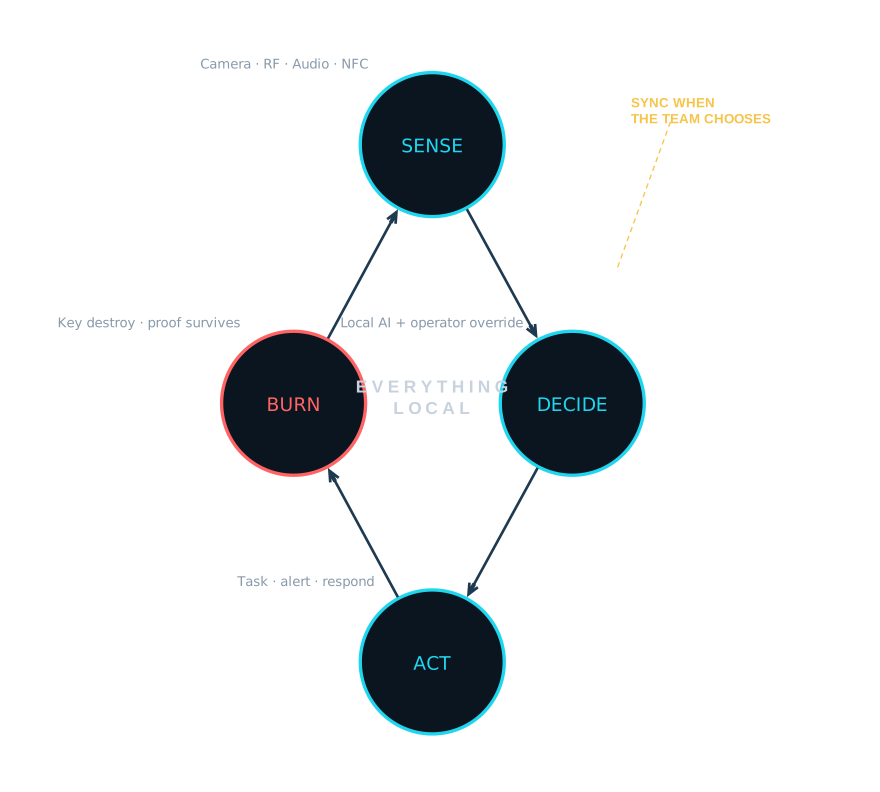
EdgeLance built the producing layer as a product and holds the position. The platform runs the full mission loop on hardware a formation already owns. It records missions as evidence from the moment of capture, runs models locally without any network dependency and turns each after action review into training signal for the next operation. The unit owns the data, the models it tunes and the intelligence that results.
The scale is a product's scale rather than a prototype's. The codebase stands at 629,791 lines. The API surface exceeds 1,000 endpoints. The entire system packages for air gapped delivery, which means a formation can stand it up from a single artifact with no cloud connection before, during or after. It is model agnostic and hardware agnostic by design. Any model a unit is cleared to run, on whatever hardware the unit already carries, on any common operating system.
The burn model is the part that operators notice first. Intelligence produced during a mission can live at mission scope and be destroyed on completion, or survive into the unit's archive under the unit's authority. Nothing leaves the formation without a decision by the formation. That single design choice is why bottom-up adoption works here. A platoon can adopt EdgeLance without asking anyone upstream for permission, because nothing upstream is involved.
The load bearing pieces are patent pending. The deeper protection is architectural. Evidence first design cannot be retrofitted, and every mission a unit records on EdgeLance widens the gap a competitor would have to close from zero.
This is a statement of intent as much as a description. EdgeLance was built to be the layer where defense intelligence is born, and to hold that ground while the consuming layers above it consolidate.
What the producer is worth to its owner
For an acquirer or a prime the position translates directly. Owning the producing layer means owning the source of everything the consuming platforms display. Lattice fuses what the edge produces. Maven tags what the edge collects. Influence over how intelligence is produced is influence over every screen downstream, without holding a single one of those contracts.
The position pays differently depending on who holds it. A prime that owns the producer feeds its own platforms first and sets the evidence standard everyone else must read. An enterprise software owner that buys the producer completes its stack from point of capture to command screen and closes the one gap a competitor could use to get underneath it. An investor holding the producer owns the layer whose switching costs are written in mission archives rather than contract terms.
The historical analogy is exact enough to act on. The mission application layer is to defense AI what the operating system was to the PC. The enterprise platforms are the new mainframes, and mainframes were an enormous business. Within twelve years of the PC's launch the profit pool had moved to the software that ran where the work happened, and the company that owned the customer accounts posted the largest loss in American corporate history.
The producing layer will consolidate the way every other layer in this stack consolidated. Someone will own the ground where defense intelligence is born, and whoever owns it will sit upstream of a 20 billion dollar fusion layer, a 1.3 billion dollar targeting layer and a half million user transport layer. The contracts prove what fused intelligence is worth. The missions prove where it comes from.
In 1981 the most valuable company in computing sold the machines that sat on desks. By 1993 the value belonged to the software that ran when the user went to work. Defense AI is standing at its 1981, with the boxes funded and the operating layer still open. EdgeLance already shipped the operating layer.